
How to keep people behind you from reading your laptop screen
In a café, a coworking space or on a train, your screen is in plain view. Someone sitting behind you can read a message or a client's email and can see which keys you press when you type your password. Here's what you can do for free, what a privacy filter does and how to know when someone really is looking.
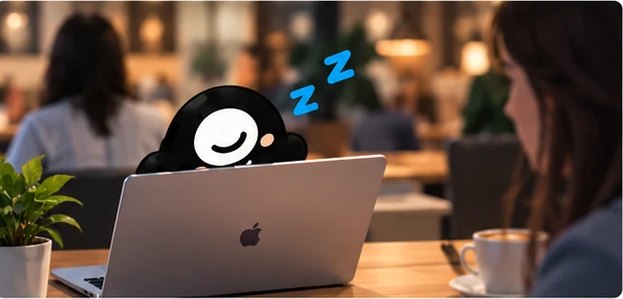
Where you sit matters most
- Pick a seat with your back to a wall. That way nobody can be behind you.
- On a train, sit by the window and turn the laptop slightly toward it.
- Avoid tables next to the door, a walkway or the bar, where people pass all the time.
- Turn the brightness down. A darker screen is harder to read from a few metres away.
macOS settings that help
- Don't show notification content: in System Settings, under Notifications, set “Show previews” to “Never”, at least while you work in public. That way a message that pops up in the corner of the screen can't be read.
- Lock the screen when you get up, even for a minute: Control + Command + Q.
- Set up a hot corner: under Desktop & Dock, click Hot Corners and choose Lock Screen for one of the corners. Move the pointer there and the screen locks.
- Get a window out of sight quickly: press Command + H for the whole app, or Command + M to minimise just the window to the Dock.
- Don't type passwords in plain view: use Touch ID and password autofill (the Passwords app, on macOS 15 and later).
The privacy filter
A privacy filter is a thin film or panel that goes over the screen. From the front you see normally, and from the side the picture turns dark. For MacBooks there are magnetic models that go on and come off in a second, and they usually cost a few tens of euros.
It has two downsides. Even from the front, the picture is a little darker and less sharp. Also, the filter only protects you from people looking from the side. Someone right behind you, a step or two away, sees the screen just as well as you do.
How to know when someone really is looking: Upsi
Upsi is a menu bar app for macOS 14 or later. It has two features for public places.
Shoulder Watch (beta). While it's on, Upsi uses the camera to notice if another face appears behind you and looks at the screen. Then the eye in the menu bar turns red. If you want, the screen blurs until the person leaves. Camera images are analysed on the Mac and discarded right away. They are not saved and not sent anywhere.
Mirror mode. Upsi opens a small window with the camera image, which you can move anywhere on the screen. This way you can see for yourself who is behind you, without turning around.
While either one is on, the camera is in use, so the green light stays on. Turn them on only when you work in public. Shoulder Watch uses a few percent of the processor, so there's no point keeping it on all day.
Upsi does one more useful thing when you step away from the table: if someone wakes your locked Mac or types a wrong password, it takes a photo with the camera and, if you want, sends it to you on Telegram.
Try Upsi free for 30 days
Every feature is included in the trial, no card needed. After that it costs €4.99 a year for one Mac. For now payment is in crypto; card payment is coming back soon. Works on macOS 14 or later.
Download Upsi for MacWhat else Upsi doesFrequently asked questions
Is a privacy filter enough?
It protects you well from people sitting next to you. It doesn't protect you from someone right behind you. For that, your choice of seat, locking the screen in time and Shoulder Watch help.
Does Shoulder Watch record what the camera sees?
No. Camera images are analysed on the Mac and discarded immediately. They are not saved and they don't leave the Mac.
What does it mean that the feature is in beta?
It means we're still improving it. Sometimes it may miss a very short glance or react to a face that only passes through the frame. If you notice something like that, write to us at [email protected].
Does it work in the evening, in low light?
The camera needs a little light to see faces. In an almost dark place, Upsi might not notice anyone.